Saturday, March 26, 2011

Bored to Death

My emphasis.

We live in days of distraction.

In his book A Secular Age, Charles Taylor distinguishes between the enchanted and disenchanted worlds. The pre-modern person lived in an enchanted world where meaning was not created but rather found in things themselves—the world was full, sometimes frighteningly full, of meaning. A bone fragment from a saint retained the sanctity and curative power of the saint, rogation days were particularly good days for planting crops and ensured a bountiful harvest, or a procession of the Virgin’s image could drive evil spirits away, for things themselves possessed their own meanings and powers, and persons lived alongside those meanings rather than creating them. Consider the popular beliefs associated with Candlemas in the late medieval period whereby the candles themselves were thought capable of protecting people from storm, sickness, and devil, or, if used by witches, of bringing harm and torment. A culture that believed in such things was likely to have a stance towards the world and its things which assumed that the world was “charged,” full of meaning, and thus to be respected, and sometimes manipulated, according to the understood rules of that world.

Things are quite different for the contemporary, postmodern Western person, occupying a disenchanted world, an uncharged world, where things are thought to mean only according to the meanings we provide to things.

So while on a given day in either 1450 or 2011 a person could alike feel irritated or angry or greedy, still the conditions of belief have changed so substantially between that charged religious world and this disenchanted secular world that the meanings of those stances are quite different. If one was alienated and estranged from the ordering of the universe in 1450, one was alienated, in a very real sense, from the ordering chosen by God; if one is alienated from the universe in 2011, one is alienated from nothing really, just a coldly impersonal set of forces. The historical and social situation has changed the meaning of our possible stances towards the world, and, correspondingly, to the possible meanings of our world.

To be a human is always to face the world with a particular stance and from a particular position. Unlike the dispassionately staring camera, we dwell in the world in a variety of moods and places, changing not just ourselves but our worlds of meaning as we do so. If my stance towards the world is one of eager and passionate interest, I tend to find the world sparkling and captivating. If I rather aggressively seek profit and gain, I tend to find the world and its inhabitants as resources or competitors. If I am bored, the world will fail to engage.

This is true of each and every person, and since each of us takes a particular stance at a given time, we will not always inhabit similar worlds of meaning—yours is now captivating, mine is now an irritant—even while we may be quite near each other in space and time, perhaps even in the presence of each other. Still, despite the particularity, as social and historical beings we might expect certain tendencies to emerge whereby persons in one cultural space, even when maintaining their own personal differences, share a vision of the world that tends not to be found in other cultural spaces.

I suggest that the stance toward the world most evident in the historical and social space of contemporary Western life is a stance of boredom. Many of us no longer find the world beautiful, or good, or of worth, and since the world and the things of the world are quite worthless in themselves, they bore us. Of course, since we too are inhabitants of this world without worth, we find almost no worth in other persons either, or in ourselves. At the same time, many find this boredom impossible to give up—we like this stance, we like the boredom—because the meaninglessness of the world allows us to treat it and others and ourselves exactly as we wish. We are free! Since the world, for us, does not have the weight of glory, we owe it nothing and can do with it precisely as we wish. But a culture of freedom without truth, a culture where freedom is unchecked by the good of being, ends up as a culture of death. Our bored culture is a culture actively engaging in a revolt against limits, place, order, and we are willing to harm and kill our world, each other—especially the weakest among us—and ourselves in a pique of freedom.


To live in a disenchanted, unencumbered world of freedom intoxicates us, to be sure, but it also casts us adrift existentially, morally, and spiritually. “What are we to do?” “What are we for?” “What is the good life?”—these and other questions are complicated in a culture where freedom itself is a final authority, and freedom that cannot be thickly defined because of the fear that definition would limit, define, and spell an end to freedom. We simply don’t know why we exist, and we hate any answer which might compel us to limit our empty freedom and actually attain the good.

Freedom is for us, now, an idol, and our conception of freedom is so absolute that we increasingly perceive any limits to be illicit and impermissible—I think of the old slogan from 1968, “it is forbidden to forbid.” So absolute are the demands of our new god that even the limits of place, of body, of community, of our own human nature, are thought a trap.  Our new freedom, this freedom from dwelling in the density of being, is a prison—a prison of freedom. Flattened and unhooked from reality, our lives can seem arbitrary and insignificant, and only an increasingly shrill insistence of our own significance remains—an insistence bearing no weight. This weightlessness, this unbearable lightness of being, results in the torpor of meaningless, the spiritually enervating results of a life considered not worth having or living.

R. J. Snell is Associate Professor of Philosophy and Director of the Philosophy Program at Eastern University.

Copyright 2011 the Witherspoon Institute. All rights reserved.

The 15th Antiphon at Matins for Holy Friday


From Preacher's Institute

This weekend, we meditate on the meaning and the power of the Holy Cross.

This is a recording of our father, Archbishop Job of Chicago singing the 15th Antiphon at Matins for Great and Holy Friday 2009.
We include it for your own spiritual edification. Contemplate this worthy meditation on the Cross in anticipation of Holy Week.
May his memory be eternal!

Friday, March 25, 2011

The Annunciation of the Virgin Mary


26 And in the sixth month, the angel Gabriel was sent from God into a city of Galilee, called Nazareth, 27 to a virgin espoused to a man whose name was Joseph, of the house of David: and the virgin's name was Mary.

28 And the angel being come in, said unto her: Hail, full of grace, the Lord is with you: blessed are you among women. 29 Who having heard, was troubled at his saying and thought with herself what manner of salutation this should be.

30 And the angel said to her: Fear not, Mary, for you have found grace with God. 31 Behold you shall conceive in your womb and shall bring forth a son: and you shall call his name Jesus.32 He shall be great and shall be called the Son of the Most High. And the Lord God shall give unto him the throne of David his father: and he shall reign in the house of Jacob for ever.33 And of his kingdom there shall be no end.

34 And Mary said to the angel: How shall this be done, because I know not man?

35 And the angel answering, said to her: The Holy Ghost shall come upon you and the power of the Most High shall overshadow you. And therefore also the Holy which shall be born of you shall be called the Son of God. 36 And behold your cousin Elizabeth, she also has conceived a son in her old age: and this is the sixth month with her that is called barren.37 Because no word shall be impossible with God.

38 And Mary said: Behold the handmaid of the Lord: be it done to me according to your word. And the angel departed from her.


 by Metropolitan Hierotheos (Vlachos) of Nafpaktos


The feast of the Annunciation of the Virgin Mary is a feast of the Lord and of the Mother of God (Theotokos). It is a feast of the Lord because Christ who was conceived in the womb of the Theotokos. It is a feast of the Theotokos because it refers to the person who aided in the conception and Incarnation of the Word of God, that is, the All Holy Virgin Mary.

Mary (the Theotokos) has great value and an important position in the Church, precisely because she was the person whom all generations awaited, and she gave human nature to the Word of God. Thus the person of the Theotokos is associated closely with the Person of Christ. Furthermore, the value of the Virgin Mary is not only due to her virtues, but also mainly to the fruit of her womb. For this reason, Theotokology is very closely associated with Christology. When we speak of Christ we cannot ignore her who gave Him flesh. And when we speak of the Virgin Mary, we simultaneously refer to Christ, because from Him she draws Grace and value. This shows clearly in the service of the Salutations, in which the Theotokos is hymned, but always in combination with the fact that she is the mother of Christ: "Rejoice, for you are the throne of the king. Rejoice for you bear Him Who bears all things".


Read the rest here.

Thursday, March 24, 2011

History of the Easter Egg

St Mary the Myrrh-Bearer 

Hunting for Easter eggs buried in the backyard is an age old tradition in the "west". But just how old is this tradition, and why the eggs?

It actually starts with Mary Magdalene. You may remember her as the woman filled with seven demons who was cured/exorcised by Jesus (Luke 8: 2-3). Later, she was also seen as one of the Myrrh-bearing women at Jesus' tomb who saw the risen Christ (John 20) "18 Mary Magdalen comes and tells the disciples: I have seen the Lord; and these things he said to me."

Mary Magdalene is honored as a Saint in the Orthodox Catholic Church, as well as the Roman Catholic Church. Existent as one of the traditions of the Church, which not being told through sacred scripture, but never-the-less an event passed within the Church, Mary Magdalene's story is the basis for our egg traditions.

The tradition is that shortly after Christ's resurrection, Mary the Myrrh-Bearer traveled to Rome to preach, and eventually gained an audience with Caesar Tiberius (14-37 AD). She denounced Pontius Pilatus, who was appointed by Tiberius, for his improper handling of Jesus' trial and persecutions by the local Jewish community. She then concluded her talk with the resurrection of Jesus Christ. Picking of a chicken egg from the table, she illustrated the resurrection. During the Jewish Passover, the egg is cracked, and eaten to symbolize new life, who's teaching is still maintained within the Church. The cracked egg for us symbolizes the opening tomb, and the new life within springs forth and nourishes us.

Tiberius, unimpressed by her religious talk, arrogantly states that a human being could never return to life... anymore that this egg could turn red! The egg in Mary's hand turned to red at this moment, proclaiming the Truth of her Faith.


Homemade Easter/Pascha eggs are astonishingly easy to make. Without the need for special dyes, all you need to turn your eggs red is a yellow onion. For a deeper color, vinegar may be added to the water. The vinegar will score the surface of the egg allowing for more color absorption.  For a different texture, the raw eggs to be wrapped in the skins of the yellow onion and then boiled together. 

Try this About-dot-com article for Greek red eggs to help make your Easter traditions more theologically Christ centered.


Source: Egg Tradition
Source: Mary Magdalene

Sunday, March 20, 2011

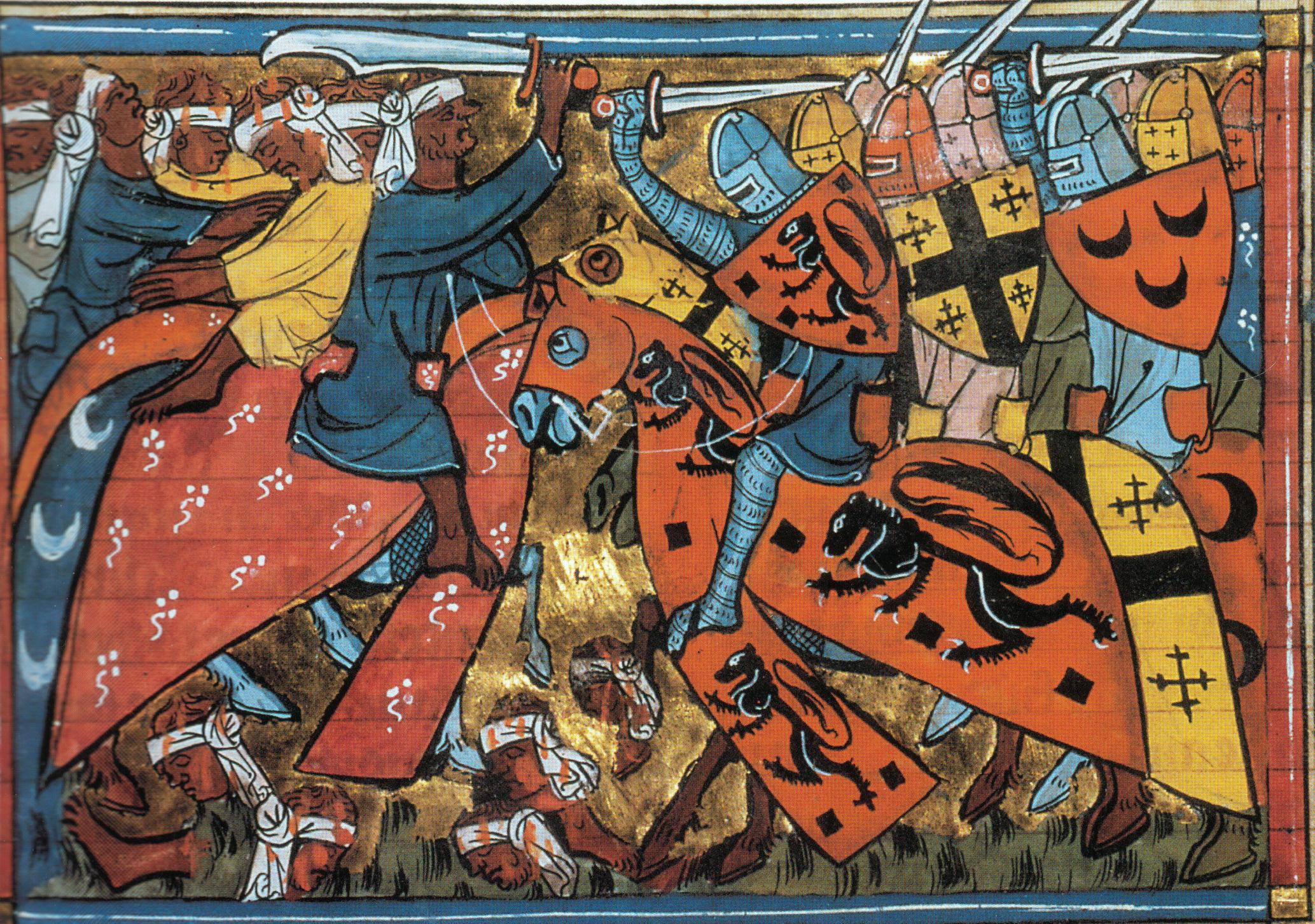
Misconceptions of the Crusades

The Crusades, a once powerful endeavor by the European civilizations to combat the Muslim forces, have been used for about 800 years as every means of political retaliation. The very word itself is often a pajorative against strong initiatives or ideologies. However, I will maintain this is not the correct point-of-view. Our society is filled with a collective consciousness that far too many take for granted. We share a worldview that is far from being static or corrupted. And this understanding of the Crusades is one of those corrupted misconceptions.

Perhaps the following article can offer you a worldview shift. Below is an important except from an article giving brief detail to one of the most misunderstood struggles of Christian and European history.

My emphasis.

Misconceptions about the Crusades are all too common. The Crusades are generally portrayed as a series of holy wars against Islam led by power-mad popes and fought by religious fanatics. They are supposed to have been the epitome of self-righteousness and intolerance, a black stain on the history of the Catholic Church in particular and Western civilization in general. A breed of proto-imperialists, the Crusaders introduced Western aggression to the peaceful Middle East and then deformed the enlightened Muslim culture, leaving it in ruins. For variations on this theme, one need not look far. See, for example, Steven Runciman's famous three-volume epic, History of the Crusades, or the BBC/A&E documentary, The Crusades, hosted by Terry Jones. Both are terrible history yet wonderfully entertaining.

So what is the truth about the Crusades? Scholars are still working some of that out. But much can already be said with certainty. For starters, the Crusades to the East were in every way defensive wars. They were a direct response to Muslim aggression -- an attempt to turn back or defend against Muslim conquests of Christian lands.

Christians in the eleventh century were not paranoid fanatics. Muslims really were gunning for them. While Muslims can be peaceful, Islam was born in war and grew the same way. From the time of Mohammed, the means of Muslim expansion was always the sword. Muslim thought divides the world into two spheres, the Abode of Islam and the Abode of War. Christianity -- and for that matter any other non-Muslim religion -- has no abode. Christians and Jews can be tolerated within a Muslim state under Muslim rule. But, in traditional Islam, Christian and Jewish states must be destroyed and their lands conquered. When Mohammed was waging war against Mecca in the seventh century, Christianity was the dominant religion of power and wealth. As the faith of the Roman Empire, it spanned the entire Mediterranean, including the Middle East, where it was born. The Christian world, therefore, was a prime target for the earliest caliphs, and it would remain so for Muslim leaders for the next thousand years.

With enormous energy, the warriors of Islam struck out against the Christians shortly after Mohammed's death. They were extremely successful. Palestine, Syria, and Egypt -- once the most heavily Christian areas in the world -- quickly succumbed. By the eighth century, Muslim armies had conquered all of Christian North Africa and Spain. In the eleventh century, the Seljuk Turks conquered Asia Minor (modern Turkey), which had been Christian since the time of St. Paul. The old Roman Empire, known to modern historians as the Byzantine Empire, was reduced to little more than Greece. In desperation, the emperor in Constantinople sent word to the Christians of western Europe asking them to aid their brothers and sisters in the East.

That is what gave birth to the Crusades. They were not the brainchild of an ambitious pope or rapacious knights but a response to more than four centuries of conquests in which Muslims had already captured two-thirds of the old Christian world. At some point, Christianity as a faith and a culture had to defend itself or be subsumed by Islam. The Crusades were that defense.

Muslims weren't the only ones to suffer casualty by the Crusades, regrettably. One of the more immediate failures of the later Crusades was the "Sack of Constantinople". An unintended secondary campaign driven by self-interest, it became an event probably more damaging than Islam ever had been to Christendom.


The Crusades of the 13th century were larger, better funded, and better organized. But they too failed. The Fourth Crusade (1201-1204) ran aground when it was seduced into a web of Byzantine politics, which the Westerners never fully understood. They had made a detour to Constantinople to support an imperial claimant who promised great rewards and support for the Holy Land. Yet once he was on the throne of the Caesars, their benefactor found that he could not pay what he had promised. Thus betrayed by their Greek friends, in 1204 the Crusaders attacked, captured, and brutally sacked Constantinople, the greatest Christian city in the world. Pope Innocent III, who had previously excommunicated the entire Crusade, strongly denounced the Crusaders. But there was little else he could do. The tragic events of 1204 closed an iron door between Roman Catholic and Greek Orthodox, a door that even today Pope John Paul II has been unable to reopen. It is a terrible irony that the Crusades, which were a direct result of the Catholic desire to rescue the Orthodox people, drove the two further -- and perhaps irrevocably -- apart.

For a reference to it's ramifications, the East/West Schism between the Roman Catholics and the Eastern Orthodox Catholics is often dated to 1054 when personal excommunications between Patriarchs were issued. However, after this event, most of the Church went along unnoticed to any "separation". The cultural tensions were still present between "Greeks" and "Latins", as always, however inter-religious dialogue continued forward. After the sack of Constantinople, popular support among the East for severed ties rose, and created the seemingly permanent split. Multiple attempts to reestablish union have failed in any true sense, and a millennium of historical and cultural differences has only exacerbated the Schism.


Full Article Here

Saturday, March 19, 2011

The Pre-Sanctified Liturgy at Christ the Saviour in Moscow with Patriarch Kirill.

On the Problem of a Stubborn and Unrepentant Heart.

In the Gospel for Wednesday, Jesus rebuked the people of his time for their stubborn and unrepentant hearts:
This generation is an evil generation; it seeks a sign, but no sign will be given it, except the sign of Jonah. Just as Jonah became a sign to the Ninevites, so will the Son of Man be to this generation. At the judgment the queen of the south will rise with the men of this generation and she will condemn them, because she came from the ends of the earth to hear the wisdom of Solomon, and there is something greater than Solomon here. At the judgment the men of Nineveh will arise with this generation and condemn it, because at the preaching of Jonah they repented, and there is something greater than Jonah here.” Luke 11:29-32
Stubborn? - It is a notable issue that sometimes sets up in both individuals and cultures, that the heart becomes obstinate, stubborn, incorrigible, and unrepentant. Increasingly, the heart becomes hardened and unlikely to change, even despite overwhelming evidence that the course one is on is destructive, and a source of pain.
Perhaps a couple of examples from our culture will help to illustrate what the Lord is teaching.
The Problem of Promiscuity – The past fifty years have featured an explosion of promiscuity. I do not argue that there was no sexual sin prior to 1960, but it is a far wider problem today both in quantity and degree. And the results of promiscuity are demonstrable and terrible: STDs, AIDS, teenage pregnancy, abortion, a devastation of marriage and family. Divorce rates have soared. Co-habitation and other alternative arrangements have proliferated. 
Children are the ones who suffer by not being raised in two-parent families under the formative influence of a father and mother, male and female. Sure enough, under stress, the rates of Juvenile delinquency have gone up [1] even as test scores [2] and graduation rates [3] have diminished. Promiscuity also leads to poverty since the chief cause of poverty in this country is single motherhood[4]. Children living in fatherless homes are 5 times more likely to live in poverty, 9 times more likely to drop out of school, 37% more likely to abuse drugs, 2 times more likely to be incarcerated, 2.5 times more likely to become a teen parent, 20 times more likely to have behavioral disorders, 32 times more likely to run away [4].
Well, you get the point. Promiscuity causes diseases, divorce, and devastation of the family, which in turns harms children through abortion, poverty and irregular family situations. Statistically, the results are clear, even staggering.
Yet, despite this, there seems little willingness in our culture to learn or even to reflect on the relationship of promiscuity to great harm. One might expect a rational person or culture to observe these sorts of results and say, “Gee, this is pretty bad. Maybe we should change the way we behave.” But not only is such a reconsideration not evident among most, but a kind of doubling down of bad behavior is occurring. There are increasing demands that the Church and other “moral police” be silenced and cease their “intolerant” attitudes. There are also demands that the government supply condoms, promote contraception, fund abortion, provide welfare that financially incentivizes single motherhood, and promote “values-neutral” sex education in schools. Even AIDs research though good and fine in itself, is often demanded in the absence of any appreciation that celibate behavior is an important aspect of prevention.
At some point we have to see how promiscuity is destroying us. The breakdown of the family is a civilization-killer. But still we seem, as a culture to be unable or unwilling to change the way we think and the way we behave.
And thus we see illustrated what the Lord condemns: a stubborn and unrepentant heart.
Another example is our greed. At some level, we know by experience that our affluence vexes us sorely. The more we have, the more stressed out we become. The more affluent we become, the more Americans go on psychiatric and psychotropic drugs [5]. We are busy and stressed trying to maintain our extravagant lifestyles. We have never lived so long and healthy, and we have never been so anxiousabout our health. We have never had so much and never been so anxious about “the economy” and “the stock market.” Money worries us constantly. We buy things we can’t afford, and our credit cards worry us. We buy, and then are not satisfied, for now a newer model has been issued and we feel “poor” (we are NOT poor) and diminished for not having the latest. More, fancier, bigger, deluxe options, but along with it, stress, dissatisfaction, and anxiety. 
Despite knowing all this (and we DO know it), we still want more. No matter the evidence, we still upgrade, enlarge, and accessorize. At some point you’d think we say, “Enough. All this stuff is driving me crazy, I think I will simplify my life, and ask the Lord to make we satisfied with essentials, or at least with less.”  But we don’t, and we stubbornly adhere to the greed (the insatiable desire for more) that we know vexes us sorely. In effect our hearts have become stubborn and unrepentant both as individuals and as a culture. It just seems we collectively refuse to change in this regard. And thus we see illustrated what the Lord condemns: a stubborn and unrepentant heart.
In Lent, we do well to ask the Lord to soften our hard hearts. The Lord said to Moses on several occasions that we are a stiff-necked people (Eg Ex 32:9; 33:3; Deut 31:27; inter al). And through Isaiah He says that our neck is iron and our forehead is bronze (Is 48:4). To Ezekiel he said we are stubborn and obstinate, not to mention hard of heart (Ez 2:4; 3:7).
It’s OK he still loves us. But we need some serious help. And Lent is a good time to appreciate that. We need this help as individuals and as a culture. We tend to be stubborn and unrepentant. We tend to justify our behavior and have a cultivated blindness that refuses to see what is plainly before us.
Two Christians were speaking. One said, in my church there are many miracles! The other asks, “So you consider it a miracle if God does someone’s will?”  “Yes!” said the other. “Hmm….” said the second, “In my church it is considered a miracle if someone does the will of God.”
Pray for a miracle.

Source